


STUDIOTOPIA is thrilled to launch the second edition of its Residency Programme, an initiative designed to foster collaboration between the arts and sciences to promote sustainable development. This year, the programme focuses specifically on the concept of the Symbiocene, exploring the interconnectedness of life on Earth through the combined perspectives of art and science.
The STUDIOTOPIA Residency Programme aims to break down barriers between disciplines by encouraging innovative cross-disciplinary approaches. This edition is open to both emerging and established talents across the arts, sciences, and academic fields. The programme is hosted by 11 specialized organizations, each facilitating unique residency opportunities with their own open calls.
Open Call for Emerging Artists:
This programme pairs each international artist with an established scientist for a year-long collaboration, focusing on local issues related to sustainable development. Cluj Cultural Centre is selecting an international artist to work and collaborate with established scientist Tibor Hartel on the theme
“If we opened people up, we’d find landscapes.”
See more details down below.
Calendar
4th September – 31st October 2024, 23:59 CET
1st November – 5th November 2024
6th November – 28th November 2024
15th November – 20th November 2024
1st December 2024 – 31st December 2025
September 2025 – March 2027
Please ensure you submit your application before the deadline. We look forward to your participation in this exciting opportunity to bridge the worlds of art and science! We will host live info sessions to provide more information about the programme, challenges, and application process:
- September 18, 2024 (10. 30 – 13.00 CEST)
- October 9, 2024 (10. 30 – 13.00 CEST)
STUDIOTOPIA Residency Programme
The STUDIOTOPIA Fellowship Programme offers 12-month residencies starting in December 2024, fostering collaboration between scientists and artists to address specific challenges. The programme includes in-person meetings, exhibitions, and events, continuing until March 2027.
Open Call for Emerging Artists
Participants: 1 international emerging artist paired with established scientist Tibor Hartel.
Residency Duration: December 2024 – December 2025.
Timeline:
- Reflection (Dec 2024 – Feb 2025): Knowledge exchange and concept refinement.
- Concept Development (Mar – May 2025): Create a detailed project proposal and mock-up.
- Evaluation (Jun – Jul 2025): Assess project impact and gather feedback. Presentation of intermediary project outcomes.
- Production (Aug – Dec 2025): Develop final artworks or prototypes with host support.
- Exhibiting (Sep 2025 – Mar 2027): Showcase at local exhibitions and in a traveling exhibition across Europe.
- Funding: €4,000 fee, plus a production budget up to €6.000.
- Support: Coverage for travel and subsistence costs, access to a wide network, and dissemination assistance.
- Opportunities: Present at major European festivals and exhibitions, such as the Ars Electronica Festival.
Meetings: At least six with the scientist, including one in-person.
Collaboration: Work with scientists to create an artistic output, such as an artwork or prototype.
Engagement: Participate in events and share progress through various media.
Complete the online application form before 31st October 2024, 23:59 CET.
For detailed challenge descriptions and eligibility criteria, please refer to the Application Guide and FAQ.
Please read the Open Call Regulations.
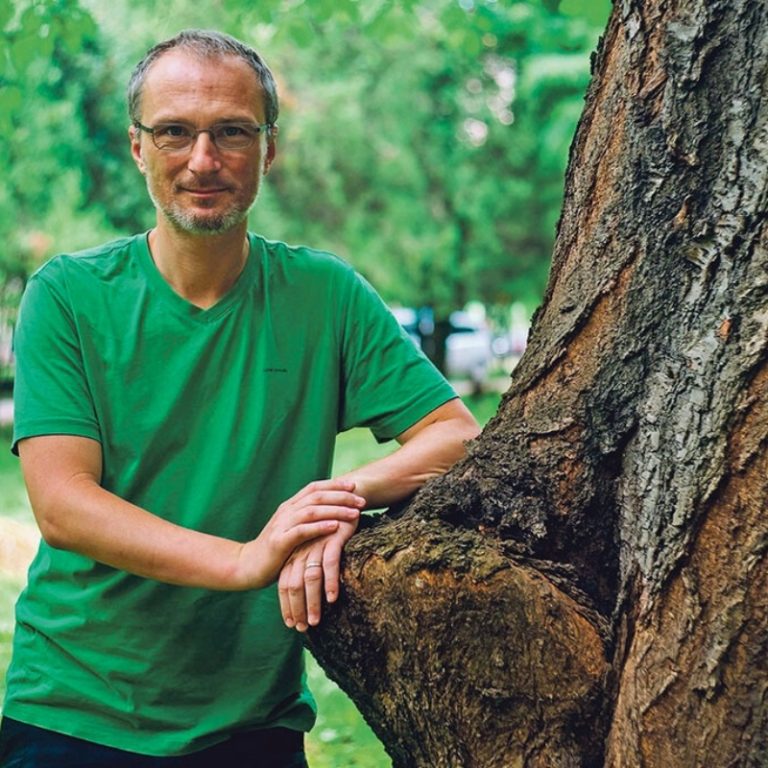
Tibor Hartel, Established Scientist
Tibor Hartel is an Associate Professor at Babes-Bolyai University, Faculty of Environmental Science and Engineering. His background is population, community, landscape ecology and conservation biology. In the past decade he increasingly broadened his areas of interest towards the human dimensions of large carnivore conservation, urban green systems and ancient land use systems (wood-pastures). He feels he can contribute to areas where knowledge types (traditional, modern) about nature and its management (land use) matters, where potential conflicts should be navigated or even solutioned, where mismatches exist between knowledge and aspirations related to land use (see The Traditional Ecological Knowledge conundrum) and where it is about (re)diversifying human-nature connections for protecting nature in production systems.
Cluj Local Challenge:
If we opened people up, we’d find landscapes
As climate change intensifies, green spaces become crucial for urban well-being. Urban trees enhance intellectual capacities, creativity, learning, and mood, while also helping navigate mental health challenges and speeding up recovery in hospitalized people. Walking in urban parks and forests promotes social health and green spaces (trees and urban forests) reduce urban heat islands and associated mortality.
The first challenge is related to the significant inequalities in access to green spaces. Cluj-Napoca exhibits extreme heat islands and lacks sufficient green spaces to buffer these temperatures. Cluj-Napoca is developing a culture at the level of the society that increasingly values the recreational benefits of urban and peri-urban green spaces. Civil society initiatives like Someș Delivery and Clujul Sustenabil aim to reconnect people with urban nature.
The second challenge is related to the enormous gap between the aspirations and visions at the level of the city governance and the increasing social demand for green spaces in Cluj-Napoca. Citizens’ participation in city planning through public consultation is increasingly needed and expected. This dissonance presents an opportunity for co-creative and deliberative activities among stakeholders in order to form a shared vision for positive human-nature futures in the city.
For additional information on the Cluj residency, please read the Challenges Booklet.
Partners
MEET Digital Art and Culture Center (MEET) – Italy, is a growing platform for digitals arts and digital culture in Milano. Through partnerships with local scientific and industrial partners, they have a strong impact in the Northern Italy region on linking arts, science and technology. MEET is a Regional STARTS Center and official partner of the NEB initiative. Its 1,500m2 have been designed by the architect Carlo Ratti in response to the challenge of creating a home for digital culture.
Ars Electronica – Austria is a major cultural institution, an educational facility and an R&D lab based in Linz, Austria. Ars Electronica represents a comprehensive approach in the confrontation with techno- cultural phenomena and enjoys a worldwide reputation for excellence. It comprises four interconnected divisions: the Ars Electronica Festival, the Prix Ars Electronica, the Ars Electronica Center and the Ars Electronica Futurelab. These 4 divisions mutually inspire one another, constituting a circuit of creativity innovative, creative, endowed with strong technical competence and implementation skills, and linked up to a global network of universities & research facilities.
The Centre for Fine Arts (Bozar) – Belgium provides an impactful pluri-disciplinary platform for the project embedded in an emblematic Art Deco building designed in Brussels by Victor Horta. With over one million visitors every year, Bozar organizes exhibitions, concerts, workshops, cinema, debates or participatory experiences with its audiences. Within its Exhibitions and Digital departments, Bozar has developed a growing cross-disciplinary interest in Art & Science programmes the past years, connecting the major arts center of Belgium to key actors in the field of AI or biotechnology developments, but also low-technology and sustainable design.
LABoral – Spain is a multidisciplinary institution which creates, disseminates and fosters access to new forms of culture rooted in the creative use of new technologies. With a transversal programming targeted at a wide public base, its goal is to share knowledge. The Art Centre acts as a platform to support artists and creators in the development of
ambitious projects in the field of the arts and industrial creation. It also has a renowned expertise in the artistic and educational field of Art & Science in Europe. It has developed for many years a qualitative programme in the field and a growing audience engagement component.
GLUON – Belgium is a non-profit organisation, that realizes projects on the crossing borders of visual art, research and industry. It has an expertise in cross-disciplinary residency management, and in educative programmes for youngsters in arts, science & technology, in line with the development of STEAM education. Gluon is part of the Vertigo-STARTS project (DG CONNECT) which focuses on technological innovation through the arts.
LAZNIA Contemporary Arts Center (CCA) – Poland is one of the 1st public cultural institutions established in Poland after 1989. Its main aims are to show latest developments in contemporary art, the process of its change, engaging cultural, social phenomena around the world, educating the public about these issues through exhibitions, artistic exchanges, interventions, innovative educational programs, academic conferences, lectures, concerts, film screenings. Its activity is divided into main fields: Art in Public Space, Art & Science, International Exchange (including residency program in and outside Gdansk), Education.
The Cluj Cultural Centre – Romania is a growing platform in Romania for Arts & Science interaction. They are also a partner specialised in extracurricular educational projects for young audiences. Through its Qub Learning Center, the Cluj Cultural Centre Association builds on its advantage of having access to a very new space that is currently being created for making and tinkering and microscopy, a team of professionals in the field of arts, research and educational facilitation and access to a network of over 25 local schools. CCC activities take into account all these facilities and connect these structures to benefit education and schools.
Hexagone, Scène Nationale Arts Sciences – France is a multidisciplinary theatre. In addition to its missions of artistic production and presentation, it has also developed since 2002 a research activity. Hexagone has thus created in 2007 the Atelier Arts Sciences, a common research and creativity platform shared with French research centre, CEA Grenoble. It provides a framework for prolific meetings between arts and sciences, allows the benchmarking of experiences and points of view, and encourages questioning and imagination to enrich respective working methods.The Atelier Arts Sciences has pioneered an art and science exhibition, EXPERIMENTA the Fair, which provides insight into on-going projects, in addition to further projects coming from European and International partners.
Kersnikova Institute – Slovenia produces and incubates contemporary investigative art projects that explore the impact of science and technology on society. It integrates several open platforms: Kapelica Gallery, a world-renowned space for contemporary investigative art; the inspirational laboratories BioTehna and Vivarium, which focus on artistic research into living systems; and the makerspace and incubator hub, Rampa Lab, where the relationships between society, technology, and art are reconsidered. The Kersnikova Institute encourages, facilitates, and showcases investigative artistic practices and projects, fosters public debate, engages citizens in science, and educates children and young people.
Digital Hub & Beta Festival – Ireland is a leading cluster of technology and digital media companies and creatives in Ireland. It is managed by the Digital Hub Development Agency, a state agency set up by the Irish government in 2003. The Digital Hub leads a range of initiatives and projects that use digital innovation to help improve the lives of people of all ages in the local community. The Digital Hub has co- founded Beta Festival, a new festival in Ireland critically engaging with technology’s impact on society through a combination of creativity, debate and experimentation.
CYENS CoE – Cyprus is a leading Research Centre of Excellence focused on Interactive media, Smart systems, and Emerging technologies. It serves as a bridge between scientific research and innovation. It is a joint venture between three public universities in Cyprus, the Municipality of Nicosia, and two international partners, the Max Planck Institute for Informatics and University College London. The Centre’s three research pillars – Visual Sciences, Human Factors and Design, and Communication and Artificial Intelligence – drive academic research and innovation, supporting sustainable scientific, technological, and economic growth in Cyprus and Europe.



The STUDIOTOPIA II programme is a continuation of the successful implementation of its pilot predecessor STUDIOTOPIA I, supported by the European Commission through the Creative Europe Program. STUDIOTOPIA II has received funding from the European Union from the European Cooperation Projects (CREA-CULT-2023-COOP-3) under grant agreement 101130939. Views and opinions expressed are however those of the author(s) only and do not necessarily reflect those of the European Union or European Commission (EC). Neither the European Union nor the granting authority can be held responsible for them.

